The angle is not a place
You do not own an angle. You own it only until the other boxer cancels it. First chapter of “Ring geometry”: what can be measured, what we are only modelling, and where the evidence stops.
“Step out at forty-five degrees.”
It is one of the most common things you hear in a boxing gym. It sounds precise. It contains a number, a direction, and almost a promise: take the right step and you will end up in the right place.
The problem is that an angle does not exist on its own.
Forty-five degrees relative to what? To the initial line between the two boxers? To the direction of the opponent's feet? To their shoulders? To the path of the jab? To the centre of the ring? And above all: while you move, does the other boxer stand still?
Boxing does not happen on a stationary sheet of paper. It is a geometry that reacts. Every position changes the available actions, and every action forces both boxers to recompute position, distance, orientation and balance.
That is why an angle is not a place you arrive at. It is a relation you have to create before the other boxer manages to correct it.
An angle becomes advantageous when one boxer stays able to act while the opponent has to spend movement and time realigning.
This is not a scientific law. It is a model: a structure simple enough to be understood, drawn, simulated and — eventually — measured. The interesting part starts right here.
The number
Forty-five degrees relative to what?
Picture two boxers facing each other. Boxer A takes a diagonal step. If B stays oriented toward the old position, A has changed the relation between the two bodies: A can see a line that did not exist a moment earlier, while B has to rotate to recover it.
Now run the same scene again, but let B follow the movement immediately. A's step is identical. The path is identical. The number is identical. The advantage is gone.
In a third scene A moves far less, but does it while B has shifted weight forward, lengthened the step and is finishing a right hand. The geometric displacement is smaller, but the correction demanded of the opponent is far more expensive.
The same angle, three outcomes
- it creates an offensive line;
- it changes almost nothing;
- it is small in space but large in time.
Research on dynamical systems applied to combat sports proposes to look at the two opponents as a single interpersonal synergy: the perceptions and actions of both athletes are coupled, and attacking and defending possibilities emerge from the relation rather than from the isolated qualities of one body. Krabben, Orth and van der Kamp identify interpersonal distance as a candidate control parameter and note that finer order parameters are needed, “such as combatant's relative orientation or relative center of mass” [2].
That is exactly the gap this essay tries to slide a model into: if relative orientation is a candidate variable and nobody is yet measuring it systematically in boxing, we may as well define it properly before pretending we understand it.
You do not own an angle. You own it only until the other boxer cancels it.
Coordinates
The ring as a frame of reference
To make the problem measurable we can, for a moment, reduce the boxers to two points on a plane. A sits at (xA, yA), B at (xB, yB). The distance between them is the formula everybody has already met at school.
Interpersonal distance
d = √( (xB − xA)² + (yB − yA)² )
But centimetres do not tell the whole story. A hundred and eighty centimetres can be an offensive distance for a tall boxer with a long reach and a dead distance for a shorter athlete. The useful measure has to be scaled to the person: we normalise distance by a characteristic length LA, for instance A's functional reach.
Normalised distance
ρA = d / LA
This is not a blackboard invention. In 2006 Hristovski and colleagues asked eight novice boxers — aged twenty-one to twenty-three, fresh out of a two-semester course in elementary technique — to hit a heavy bag fixed to the wall. They prescribed no specific punches, only that the boxers maximise efficiency and variety. The metre in front of the bag was calibrated into ten ten-centimetre segments, and at each distance every athlete threw sixty punches.
The result is that jabs, hooks and uppercuts did not appear with the same probability at every distance: there were critical values of scaled distance at which a whole class of punches appeared in or dropped out of the repertoire. Around a scaled distance of roughly 0.6 the authors located the region of maximal metastability — the region where a boxer can switch between punch types with the greatest flexibility [1].
The target was immobile and bolted to a wall. The participants were novices. The stance was constrained to a parallel position. There were no threats, no feints, no defences, no counters. And yet the essential point holds: distance, scaled to the body, changes the space of possibilities.
Distance does not only measure how far the target is. It measures which decisions are still credible.
Orientation
A boxer is not a point
Two points are useful but incomplete. A boxer has a direction: feet, hips, shoulders and guard are not oriented the same way at every instant. Two athletes can sit at the same distance and have completely different options.
So we give each boxer an orientation vector, oA and oB, and call rAB the vector running from A to B. The signed angle between A's facing and B's position is:
A's angular error
βA = atan2( det(oA, rAB), oA · rAB )
How to read βA
- near 0°: A is facing B;
- positive: B sits on one side of A's facing direction;
- negative: B sits on the other;
- the larger the absolute value, the more rotation is needed to find the target square again.
The same formula, applied to B with the vector rBA, gives βB. At this point we are no longer only asking “where are the boxers?”, but how much A faces B, how much B faces A, and which of the two has to correct their structure more to become operational again.
Interactive demo
Move A, turn B, watch what happens to G
Top-down view. Drag A or use the sliders: distance, exit bearing, and the facing of both boxers. Every value below is computed from the geometry on each frame, using the same formulas as this essay.
- d
- 1.65 m
- ρA = d / LA
- 1.83
- βA
- 0.0°
- βB
- 0.0°
- G = |βB| − |βA|
- 0.0°
Symmetric relation: neither boxer has to correct more than the other.
Drag A or use the sliders. Every value is recomputed from the geometry, none of it is canned.
Asymmetry
G, or who has to correct more
From these two measures we can build a very simple indicator.
Geometric asymmetry
G = |βB| − |βA|
How to read G
- G ≈ 0: the two boxers face each other to a similar degree;
- G > 0: A is better aligned toward B than B is toward A;
- G < 0: the relation geometrically favours B.
If A has |βA| = 8° and B has |βB| = 38°, then G = 30°. A is looking almost straight at B; B has to rotate thirty degrees more to rebuild a comparable alignment. This is the kind of position a gym would call “taking the angle”.
But the number alone does not award the advantage. A might be out of range. A might have crossed feet. A might be falling sideways. A might have won a nice photograph without owning a single available punch. That is why G has to be read together with at least two other conditions.
Minimal state of the relation
S = ( ρA , G , bA )
The third variable is the hardest. Balance cannot be deduced from the position of a point: it needs information about the feet, the centre of mass and the phase of the movement. Biomechanics helps explain why. Dinu and Louis analysed the cross, hook and uppercut with seventeen inertial sensors on twenty-three boxers — fifteen elite and eight junior — and found systematic differences not only in the force produced but in how body segments contributed: juniors compensated with the shoulder, elite boxers recruited elbow and pelvis better [3].
A 2025 study measured lower-limb contribution with dual force plates in ten amateur boxers, before and after a nine-and-a-half-minute fatiguing circuit: punch force dropped by an average of 4.26%, with the largest reductions on the cross and the left hook [7]. The useful conclusion is not that a single correct biomechanical position exists. It is more cautious than that.
An angle without a base is a photograph. It is not yet an action.
Time
The angle buys time
Geometry becomes tactics when it produces a delay. Suppose A leaves the line at some instant. B starts to rotate, resets the feet, recovers the target, and becomes sufficiently aligned again later. The difference between those two instants is the realignment window.
Realignment window
τ = t_realign − t_exit
To measure it for real you need a threshold declared before the analysis: we treat B as realigned when their angular error falls back under a tolerance ε.
|βB| ≤ ε
This definition is still incomplete without looking at the base: a boxer can have the torso apparently pointed at the target and still be unable to transfer weight, defend or counter. But τ lets us ask a better question than “how many degrees did it create?”.
For how long did the movement force the opponent to chase a relation that had already changed?
This is where the check hook and the pivot start to make sense. The hook is not just a punch that lands while the other boxer comes in; the pivot is not just an elegant turn. The combination tries to leave the opponent oriented toward a position that no longer exists.
Simulation
Three opponents, the same step
So far these are words with symbols in them. To see whether the model says anything, I wrote a kinematic simulation: A exits along a 17° arc around B's position, at constant tangential speed (about 1.4 m/s), staying oriented on the target. B is a tracker with only two parameters — a reaction latency and a maximum angular velocity — and is run in three different ways. The pivot lasts 0.35 seconds and starts at 0.30. Integration step 5 milliseconds, horizon 2 seconds, initial distance 1.65 metres, functional reach 0.90 metres, tolerance ε = 12°.
The three scenarios
- STATIC — B does not turn at all.
- REACTIVE — B starts after 0.12 s and turns at up to 220°/s.
- COMMITTED — B's weight is forward: for 0.35 s B keeps walking along the old line at 1.1 m/s, and only then starts turning, at 140°/s.
None of these constants is measured on real athletes. They are editorial assumptions, declared in the code and in the report. But once they are fixed, everything else — βA, βB, G, ρA, τ — is computed from the geometry at every step, not drawn by hand.
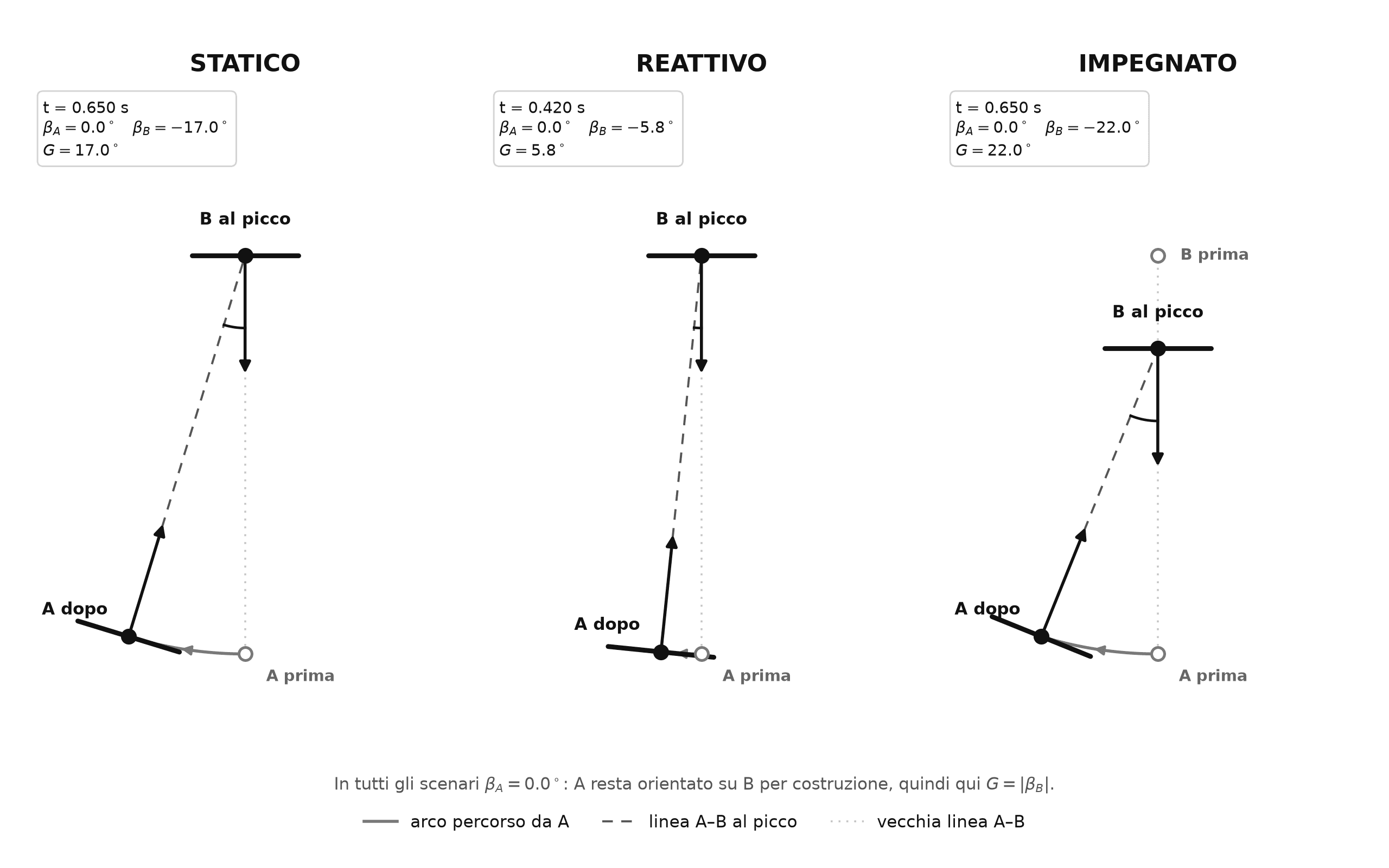
The same 17° step, three different opponents, each at its own moment of peak asymmetry. Figure generated by the simulation.
Simulation and figure: raffaelezarrelli.com
Simulation results
| Scenario | Peak G | Time of peak | Measured τ |
|---|---|---|---|
| STATIC | 17.0° | 0.65 s | beyond the 2 s horizon |
| REACTIVE | 5.8° | 0.42 s | 0 s — never exceeds ε |
| COMMITTED | 22.0° | 0.65 s | 0.42 s |
The third result is the one I care about. Against the opponent committed forward, peak asymmetry exceeds what the same step achieves against a completely motionless opponent: 22.0° versus 17.0°. A's step is identical in all three cases. The difference is that B was still investing along the old line.
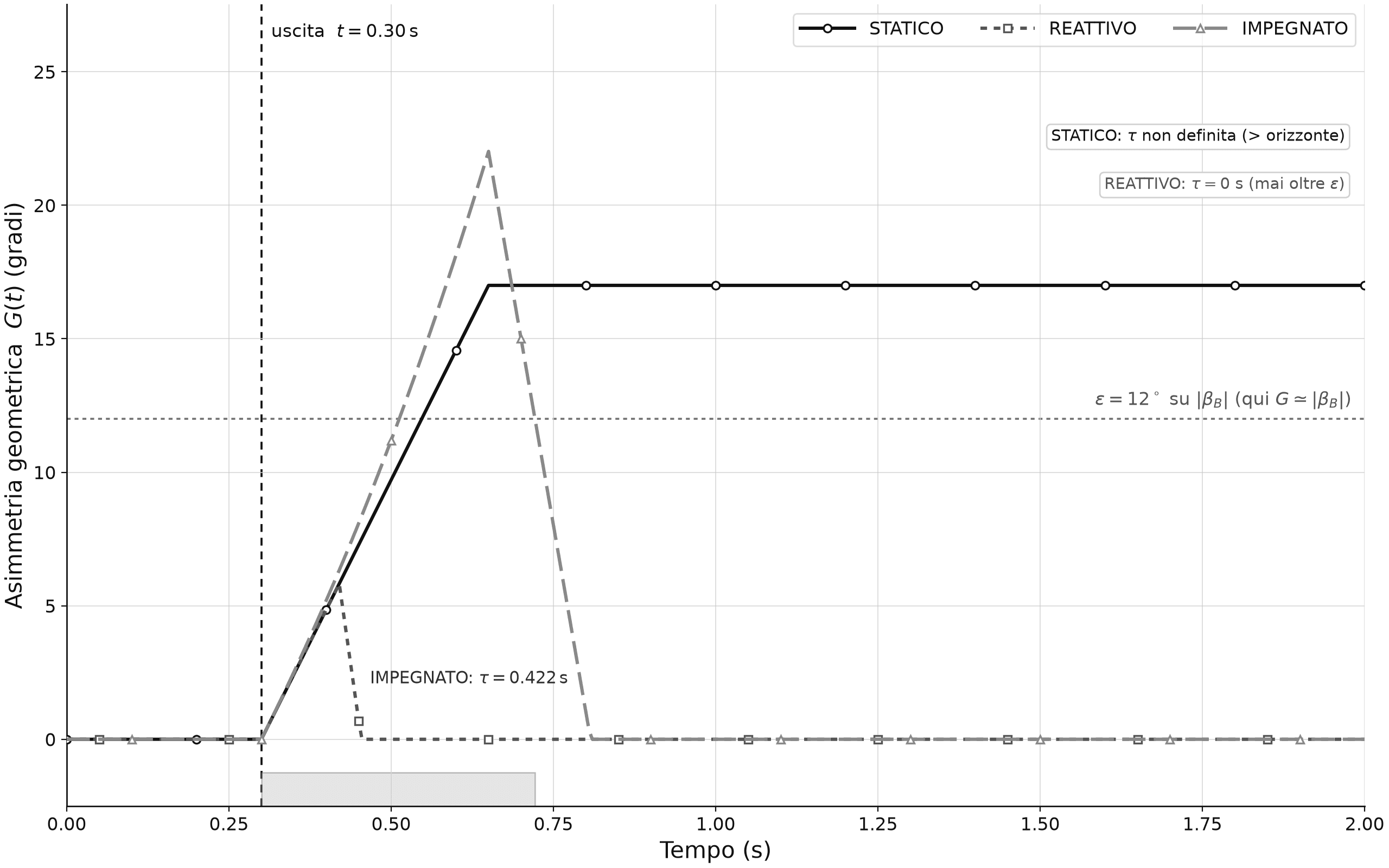
G(t) across the three scenarios. Against the reactive opponent the curve never crosses the threshold: the advantage is never born.
Simulation and figure: raffaelezarrelli.com
And there is a second detail the model only makes visible because it was forced to be explicit: a pure pivot around the opponent preserves distance. In the first two scenarios ρA stays nailed to 1.83. It only changes in the third, and not thanks to A: it is B who, by walking forward, closed the distance on themselves.
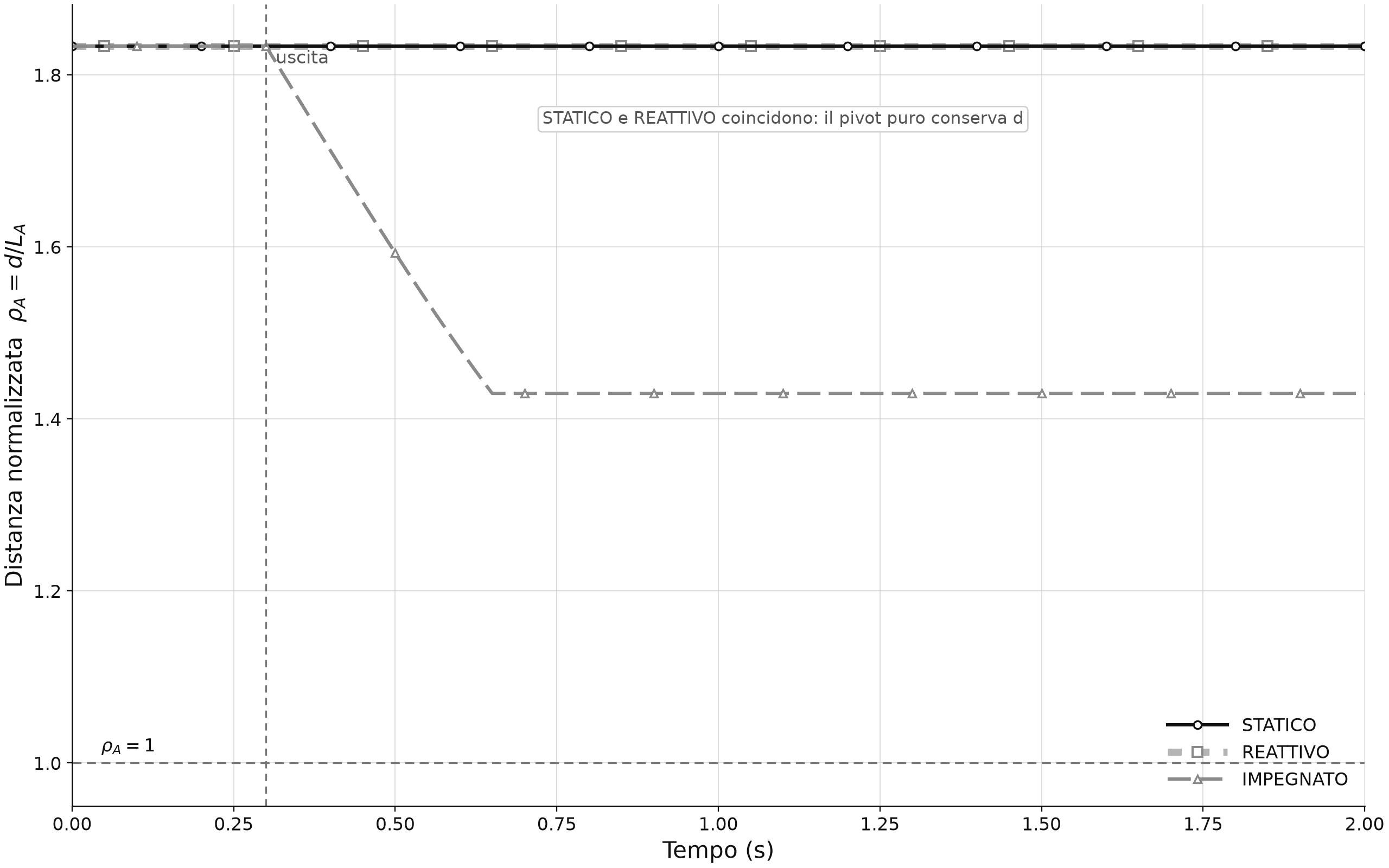
ρA(t). The pivot alone does not close distance: in the committed scenario it is the opponent who closes it.
Simulation and figure: raffaelezarrelli.com
It is a kinematic toy. It contains no feet, no centre of mass, no balance, no weight transfer, no feints, no punches, no offensive capacity. The latencies and angular velocities do not come from a distribution measured in the literature: I chose them. It has not been calibrated or validated against video, sensors or competitive results. It shows the geometric consequences of the stated assumptions, and nothing else. The code is public precisely so anyone can change those numbers and see what happens.
The full script — simulation, τ measurement and generation of all three figures — can be downloaded here: numpy and matplotlib are enough to rerun it and reproduce exactly the figures quoted above.
The visible angle is in space. The usable advantage is in time.
Speed
Fast does not mean available
We are used to imagining a fight as a race of speed: who starts first, who moves the hand faster, who gets there first. But the time of an action is not the speed of the punch.
Piorkowski, Lees and Barton compared jabs, crosses and hooks in ten competition-standard athletes, captured with an eight-camera optoelectronic system, thrown either as a single maximal punch or inside a combination. Hooks reached higher contact velocities than straight punches, but with significantly longer delivery times. And the single maximal punch hit 9.26 m/s against 7.49 m/s for the same technique thrown out of synch inside a combination [6].
These are laboratory numbers, not free sparring. They do not tell us which punch “is better”. But they remind us that speed, execution time and tactical availability are three different things. A theoretically fast punch is unusable if the body first has to rotate, recover the feet or find the target again. A slower punch can arrive earlier because it starts from a structure that is already loaded.
What a serious analysis of the angle should separate
- the time needed to see the target again;
- the time needed to orient the body;
- the time needed to produce a credible response.
Geometry creates or removes these times before the punch even starts.
Quality
Advantage is not volume
A favourable position is not there to produce more actions. It is there to improve the quality of the actions available.
Dunn and colleagues analysed twenty-six amateur boxers across nineteen bouts at the 2015 Australian national championships, elite male divisions. Winners did not throw more punches than losers: total volume was similar. They were more accurate. 33% of their punches were scored as landing, against 23% for the losers, and completely missed punches fell from 27% to 17% [4].
The sample was small and the judging system studied was the amateur ten-point must system. We cannot turn these percentages into a universal rule. But the principle is consistent with our problem: a good angle is not judged by the number of steps or punches it generates, but by the improvement in the quality of the relation.
- more opportunities to land;
- fewer opportunities to be hit;
- more control over the response;
- less need to restart the exchange from a neutral position.
A 2025 study of the twelve finals of the 2023 IBA Women's World Championships recorded 1,323 offensive and 1,456 defensive actions. The winners performed fewer offensive actions than their opponents (635 against 688) but with consistently higher effectiveness ratios across all three rounds. And — this is the part that concerns us — pivoting was the action most strongly associated with winners, with a standardised residual of +4.77 [5].
In the same study, shifting back on its own was also associated with winners (+2.99), while the combination “shifting back plus counterattack” showed only a positive trend (+1.79) that did not reach the significance threshold. That difference is worth not flattening: the data support the pivot and the step back, not yet the full sequence.
And in any case, association does not prove that pivoting makes you win. The best athletes may pivot well because they already possess superior timing, reading, balance and precision. The causal direction is not established. But the result makes the question worth studying.
Does the movement really create a better position, or is it just the visible sign of a broader technical ability?
Errors
Three ways to get angles wrong
The first is hunting for the perfect angle. No number works independently of stance, distance, reach, speed and the opponent's state. Forty-five degrees can be too many if they take you off your base. Ten can be enough if the other boxer is already committed. Thirty can be useless if the opponent turns with you. The correct angle is the smallest change that produces an operational difference.
The second is confusing lateral movement with advantage. Moving sideways does not automatically take you off the line of attack: you can move laterally and stay perfectly readable, you can even accompany the opponent's realignment and leave the symmetry intact. That is exactly the REACTIVE scenario of the simulation, the one where G never crosses the threshold.
The third is stopping the analysis at the best frame. A photograph can make a position that lasts a tenth of a second look dominant. The important variable is not the peak of G, but its evolution: G(t). A good movement produces a rapid rise in asymmetry and holds it long enough to allow an action. A decorative movement produces a spectacular peak and collapses immediately.
Levels
What we know, what we are only modelling
To give a project like this any weight you have to avoid the most common failure of sports writing: mixing scientific results, technical experience and metaphors as if they were the same thing. It is better to declare the levels separately.
Evidence
- Distance scaled to the body changes the selection and probability of actions in a boxing task against a static target [1].
- Performance in combat sports emerges from the co-adaptation of the two opponents; interpersonal distance, relative orientation and relative centre of mass are candidate variables for describing it [2].
- Punching technique involves a chain of segments and forces that cannot be reduced to arm movement, and it degrades with fatigue [3][7].
- Accuracy and action quality separate winners from losers better than raw volume, in some observed samples [4][5].
Model (ours, not validated)
- a position and an orientation for each boxer;
- a normalised distance ρA;
- a geometric asymmetry G;
- a realignment window τ, with a threshold ε declared in advance.
Hypothesis (to be tested)
- When a boxer produces a positive value of G, stays inside their usable distance and keeps an operational base, the probability of landing without receiving an immediate response increases.
These variables do not constitute a system for awarding points or predicting a winner. They exist to turn vague words — “line”, “angle”, “off-axis” — into more precise observations.
Protocol
How you would actually measure it
The first study does not need laboratory sensors. It needs definitions better than a coach's memory. You could start from technical sparring filmed with a fixed, elevated camera: the top-down viewpoint reduces perspective distortion and lets you mark the approximate centre of each boxer, the feet, shoulder orientation, the start and end of the displacement, the moment of the punch and its outcome. Each exchange becomes one row.
Minimal dataset structure
| Variable | Description |
|---|---|
| distance_norm | distance divided by the attacker's functional reach |
| beta_attacker | attacker's angular error relative to the target |
| beta_defender | defender's angular error relative to the attacker |
| G | geometric asymmetry |
| tau | time the defender needs to realign, with ε declared |
| movement | pivot, diagonal step, lateral step, step back |
| attack_result | clean, partial, blocked, missed |
| counter_2s | counter received within two seconds |
| base_stable | operational judgement of final stability |
The hard part is not computing the formulas. It is deciding consistently when a pivot begins, when it ends, what “clean punch” means and how to recognise a stable base. Thomson, Lamb and Nicholas built a notational analysis template for amateur boxing and assessed its reliability: repeated observations by the same analyst were solid, with agreement between 80% and 100%, while agreement between different analysts was distinctly less impressive, even though it improved with tolerance margins [8].
Data does not become objective because you put it in a spreadsheet.
What the protocol should include
- an operational glossary;
- positive and negative video examples;
- a second independent annotation on at least 15–20% of the exchanges;
- publication of the criteria before the results;
- explicit declaration of ambiguous cases.
There would be no need to present the work as settled truth. It would be enough to call it what it is: an exploratory study.
Limits
Geometry does not replace boxing
A model always risks falling in love with its own variables. We could measure an angle perfectly and miss a feint. We could compute distance and fail to see that a boxer is tired. We could record shoulder orientation and miss a hand controlling the line of sight, a frame on the forearm, a foot blocking the exit.
The fight is bigger than its representation. The job of the mathematics is not to reduce it to five numbers. It is to force us to specify what we believe we are seeing.
When you say “he created an angle”, the model forces you to ask
- how much did the relation change?
- who was still oriented?
- who was inside their own distance?
- who had a usable base?
- how long did the advantage last?
- what did it produce?
If we cannot answer, maybe all we saw was a good-looking movement.
Closing
The point is not leaving the line
Boxing is often narrated through places: the centre, the ropes, the corner, the inside. But none of those places holds value on its own. The centre is useful as long as it lets you choose. The ropes are dangerous as long as they reduce your exits. The inside favours whoever manages to operate first. An angle exists only as long as it asymmetrically changes what the two boxers can do.
That also changes how you train it. Drawing an X on the floor and stepping onto it is not enough. You need a task in which the opponent can react, follow, anticipate or lose the line. You need to check the final position. You need to know whether the movement produced a punch, an escape, a new entry, or only the need to start over.
The angle is not the point you arrive at. It is the time you force the other boxer to spend before you become available again.
You do not need to move far. You need to change the relation early enough to be ready before the other boxer has finished correcting it.
The quantities G and τ presented here are original conceptual models proposed for the “Ring geometry” series. They are not clinically or competitively validated metrics and must not be used as automatic tools for judging, selecting or prescribing training. The evidence cited comes from studies with different designs, populations and contexts — heavy-bag trials, standardised biomechanical analyses, notational analysis of bouts — and is not directly interchangeable: it is used to build testable questions, not to support the existence of a universally optimal angle.
References
- [1]Hristovski, R., Davids, K., Araújo, D., & Button, C. (2006). How Boxers Decide to Punch a Target: Emergent Behaviour in Nonlinear Dynamical Movement Systems. Journal of Sports Science and Medicine, 5(CSSI-1), 60–73.
- [2]Krabben, K., Orth, D., & van der Kamp, J. (2019). Combat as an Interpersonal Synergy: An Ecological Dynamics Approach to Combat Sports. Sports Medicine, 49(12), 1825–1836.
- [3]Dinu, D., & Louis, J. (2020). Biomechanical Analysis of the Cross, Hook, and Uppercut in Junior vs. Elite Boxers: Implications for Training and Talent Identification. Frontiers in Sports and Active Living, 2, 598861.
- [4]Dunn, E. C., Humberstone, C. E., Iredale, K. F., Martin, D. T., & Blazevich, A. J. (2017). Human behaviours associated with dominance in elite amateur boxing bouts: A comparison of winners and losers under the Ten Point Must System. PLOS ONE, 12(12), e0188675.
- [5]Martusciello, F., Perazzetti, A., Kaçurri, A., & Tessitore, A. (2025). Notational Analysis of the Final Matches of the 2023 IBA Women's World Boxing Championships. Journal of Functional Morphology and Kinesiology, 10(3), 350.
- [6]Piorkowski, B. A., Lees, A., & Barton, G. J. (2011). Single maximal versus combination punch kinematics. Sports Biomechanics, 10(1), 1–11.
- [7]Stewart, C., Cornett, R., Baker, J. S., Gu, Y., Dutheil, F., & Ugbolue, U. C. (2025). The Role of Lower Limb Kinetics in Boxing Punches and the Impact of Fatigue on Biomechanical Performance. Bioengineering, 12(12), 1355.
- [8]Thomson, E., Lamb, K., & Nicholas, C. (2013). The development of a reliable amateur boxing performance analysis template. Journal of Sports Sciences, 31(5), 516–528.